Showing posts with label cctv systems. Show all posts

Tuesday, April 17, 2012

Research and Markets Reveal Market Forecast for the CCTV Industry

Over the last few years, there has been an increase in demand for video surveillance products such as video baluns, CCTV security cameras, and DVR surveillance. This is because consumers are now becoming more protective of their properties and surveillance is not just for business but for homes as well. CCTV manufacturers and video balun retailers now experience a surge in the industry as the demand for technically-advanced surveillance systems continue to rise.

ResearchandMarkets.com, considered as the world’s largest market research resource, has recently released a report forecasting the global CCTV market up until 2014. According to the report, “the market for the global CCTV will reach around US$ 23.5 Billion by the end of 2014,” with the Compound Annual Growth Rate (CAGR) of about 20.5% from today.

Accordingly, the report also indicated how the switch from analog CCTV cameras, which are currently the dominant products in the market today, to network IP will happen by the end of 2014. The report also discussed what factors will affect this change into the IP technology market, especially now that IP Storage Area Network (IP SAN) is becoming more in demand than conventional DVRs and NVRs. The evolution of video analytics is also largely affected by threats of terrorism and businesses and other establishments are finding more cost-effective but equally advanced ways to monitor their properties.

In terms of technology, the use of CCTV systems is prevalent in both the transportation and retail sectors, not only for valuable management information but for safety purposes as well. It discussed how video surveillance as a service of VSaaS is quickly an emerging trend in CCTV systems too. By 2014, the regions of Asia and the Middle East will be major players in the global CCTV market while India and China will continue to be key drivers because of their large population.

SOURCE

Wednesday, February 29, 2012

How to Use a Computer Monitor for CCTV Security Cameras


Earlier, we taught you how to be more practical by using computers to monitor your home surveillance systems. Our previous post focused on wireless security cameras and it is amazing how technology makes everything so easy nowadays. With just a simple click, you can easily monitor your home using a wireless security camera.

If, however, you opt for CCTV security cameras, you will need a different configuration and you probably will have to purchase additional hardware to connect your camera to your computer. You may not use video baluns in this case because there are different cables that you need. It’s not that difficult. Find out how:

1. The first thing you have to do is to purchase a video-to-VGA converter box. Analog video data on computers are displayed using VGA inputs but with CCTV security systems, they use standard video ports similar to those used by television sets. Unfortunately, they do not have native compatibility so you have to buy a video-to-VGA converter box in order to use your CCTV security camera.

2. A VGA switch box is another thing that you have to buy. Because a monitor only has one video port, you will need a VGA switch box so you can easily switch between the camera and computer video feeds.

3. A CCTV security camera has a video feed cable which you should attach to the video-to-VGA converter box. Additionally, you should also attach a VGA cable between the converter box and VGA switch box.

4. Now, the computer’s monitor cable should also be plugged into the other port of the VGA switch box. Another VGA cable from the switch box should be attached to the computer monitor as well.

5. You can now monitor your home using your computer simply by switching the feed from the computer to the camera. This way, you can still multitask and do other things on your computer while switching to the camera feed from time to time.

Tuesday, February 28, 2012

CCTV Camera: Back to Basics

If by now you have noticed how we’ve been going on and on about CCTV cameras without actually offering an introduction to what it really is, then we do apologize sincerely. This week, we shift our focus to CCTV cameras as we share interesting facts about one of the most useful tools for businesses and residential locations. Of course, CCTV cameras work best if you have video baluns and other necessary parts available. CCTV video baluns are also available in the market today. Before we delve deeper, first let us discuss the importance of a CCTV camera.

Aside from commercial and residential establishments, major cities are now investing heavily on CCTV cameras to keep close watch on what goes on in the streets when citizens think no one is looking. Of course, as you all know, the primary purpose of a CCTV camera is to provide surveillance. Crimes are so much easier to solve with evidence from a CCTV camera. Aside from being a watchful eye, a CCTV camera can also prevent an individual from doing a crime. Imagine planning something evil only to find out that the store or house actually has a CCTV camera. Nope, those plans will be thwarted soon enough.

CCTVs, when it first developed in 1970s, were actually analog in nature. In today’s world, there are rare technologies that are still on the analog type and CCTVs have evolved to keep up with digital evolution. With digital CCTV systems, they become easier to manage as there is no longer the need for large cable systems to transmit and encode data.

Of the 25 million CCTVs in the world today, 2.5million of those are found in the United Kingdom. According to the numbers, the average citizen is caught on CCTV cameras at a rate of 300 times a day, and that is just in major cities like London.

Today, CCTVs play a large role in preventing theft, robbery, and other major crimes. In fact, it has been a useful tool in identifying the perpetrators of the July 2005 bombing in London. Setting up a CCTV camera system for your home is a wise idea. With the right tools and parts such as video baluns, it won’t be long until your home or business is protected from evildoers.

Wednesday, February 8, 2012

The Best Areas to Install Security Cameras


Security cameras need to be installed in strategic areas to maximize its investigative and deterrent value. There are two reasons why homes and business establishments prefer to have security cameras installed in their locations – to investigate what happens when a crime or accident occurs and to prevent individuals from doing something they otherwise would do without a security camera to watch their every move.
For both homes and commercial establishments, installing security cameras in entrances and exits are the best venues to get facial images of visitors who come into your store or home. A useful ID image can be easily captured with a security camera set to view an area of about three feet wide, which is the width of average doors.
For commercial areas, security cameras should be installed at customer transaction points. This means placing security cameras at cash registers, teller stations, and kiosks. They should be situated 7ft high, looking directly into the area to make sure that the camera does not capture just the heads of the people who pass by or come in to the area’.
Also install security cameras at highly-targeted areas or objects. Cash drawers, safes, filing cabinets, jewelry storage, or any valuable object that stores equally valuable documents or things should have a security camera installed nearby. Thieves will target these storage areas because of the information and valuables stored in them.
Finally, secluded areas should always be equipped with security cameras. Vandalism and violence are common in areas where not much traffic occurs so the deterrent value of the security camera will come into play. Potential perpetrators will think twice about committing anything short of a criminal act if they know that eyes are lurking behind the shadows, watching their every move.
Security camera installation is not easy and there are times that professionals need to be asked for assistance. Video baluns and CCTV systems are just some of the add-ons to learn about if you plan on installing a security camera in your home or business.

Tuesday, January 24, 2012

Install CCTV Systems Successfully with These Tips (PART II)

Earlier, we taught you how successfully install CCTV systems by sharing a few tips. Of course, installing CCTV systems mean that you have to purchase the necessary parts such as security cameras and video baluns for the system to even function properly. With good planning, CCTV system installation should prevent future problems though troubleshooting is inevitable with years-old security systems.

While the first part of our series discussed the importance of doing proper research, canvassing the area, and checking for nearby power sources, we now conclude by detailing why security lighting, camera considerations, and choosing between cabled or wireless camera is a crucial part in successfully installing CCTV systems.

The reason why you want to install a CCTV system is to make sure you are always safe and that no intruders will come into your home, especially during at night. Having enough security lighting is important if you want the system to be turned on at night. This means that you either have to make extra lighting available or choose a security camera with low lux ratings or Infrared capability.

As CCTV systems are traditionally installed outdoors, they have to be enclosed in a weather-proof protective casing to safeguard them from external elements that could potentially damage the system. Additionally, it is necessary to choose the right security camera for the type of climate in your region because there are certain security cameras that cannot withstand extreme temperature changes.

Finally, cables are necessary parts of any CCTV installation system. Some CCTV installers find it time-consuming to run cables from the camera to the control point. Wireless systems now eliminate the necessity of extensive cabling; however, the camera has to be within range and minimum obstacles should block the signal between the camera and receiver. Video baluns make long distances possible without loss of signal and transmission.

Thursday, January 19, 2012

Install CCTV Systems Successfully with These Tips (PART I)

Home installation of CCTV systems is often terminated because people are concerned on how to actually install one. There will always be problems in installing CCTV systems but good planning should help lessen the drawbacks in setting up security cameras and video baluns in your home.

Before shelling out hundreds or thousands of dollars in a security system, proper research should always be conducted first. The right security system for your home should be installed so if you are in doubt, consult a professional first to avoid wasting big bucks. A CCTV professional installer can first do a home survey to advise you of the most appropriate equipment for your house and to solve any potential problems that may arise.

Canvass the area by checking out if there are enough power sources where security cameras will be installed. One usual problem that arises in CCTV system installations are lack of a nearby power source. There’s nothing worse than stepping out with your CCTV in hand only to find out that there isn’t a single source where you can plug it in. If you find out that there is no power source available, consult your local professionals first. Sometimes, talking to them will take you to an entirely different direction as compared to doing it yourself.

Alternatives to power source problems would be to have a nearby power source installed to where you want to install the security cameras. Cables can be used from an existing power outlet inside your house. Video baluns can help boost signal and prevent distortion or interference. Another option is to invest in a CCTV camera that gets its power from a plug-in battery unit.

There are many things to consider before actually buying a CCTV system first. Follow these ideas to avoid wasting precious money and to guarantee that your security system will work for you.

Wednesday, December 28, 2011

Determining What Video Baluns to Based on Distance

Find out what is the best combination for active and passive video baluns to use based on the distance required for your CCTV system.


Monday, December 26, 2011

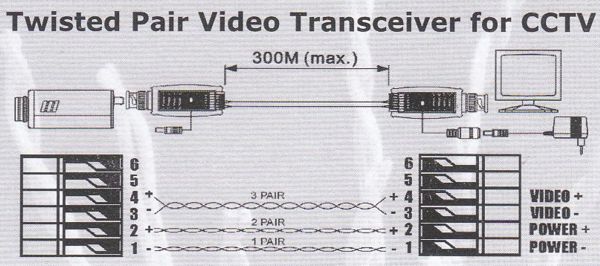
Video Baluns and Twisted Pair Video Transceivers for CCTV

From this diagram, learn how video baluns are used and applied in CCTV systems.


Friday, December 23, 2011

How to Install Large CCTV Systems Using Video Baluns and Rack Cabinets


A quick diagram on how to build large CCTV systems with video baluns and rack cabinets